
Hand Made to Order
(7-12 Business Days to Manufacture)
Hand Made to Order
(7-12 Business Days to Manufacture)
Hand Made to Order
(7-12 Business Days to Manufacture)
Hand Made to Order
(7-12 Business Days to Manufacture)
Hand Made to Order
(7-12 Business Days to Manufacture)
Hand Made to Order
(7-12 Business Days to Manufacture)
Hand Made to Order
(7-12 Business Days to Manufacture)
Hand Made to Order
(7-12 Business Days to Manufacture)
Hand Made to Order
(7-12 Business Days to Manufacture)
Hand Made to Order
(7-12 Business Days to Manufacture)
Hand Made to Order
(7-12 Business Days to Manufacture)
Hand Made to Order
(7-12 Business Days to Manufacture)
Hand Made to Order
(7-12 Business Days to Manufacture)
Hand Made to Order
(7-12 Business Days to Manufacture)
Hand Made to Order
(7-12 Business Days to Manufacture)
Hand Made to Order
(7-12 Business Days to Manufacture)
Hand Made to Order
(7-12 Business Days to Manufacture)
Hand Made to Order
(7-12 Business Days to Manufacture)
Hand Made to Order
(7-12 Business Days to Manufacture)
Hand Made to Order
(7-12 Business Days to Manufacture)
Hand Made to Order
(7-12 Business Days to Manufacture)
Hand Made to Order
(7-12 Business Days to Manufacture)
Hand Made to Order
(7-12 Business Days to Manufacture)

Hand Made to Order
(7-12 Business Days to Manufacture)
Gold band rings for ladies represent one of the most enduring categories in fine jewelry — simple in silhouette, but with meaningful differences in metal, width, and finish that shape how a ring wears over years and decades. Goldia's collection spans 10K and 14K gold in yellow, white, and rose tones, from slim half-round bands with clean polished surfaces to diamond eternity rings set with lab-grown and natural stones in channel, shared prong, bezel, and U-prong configurations. Whether the goal is a low-profile everyday band, a classic wedding ring, or a diamond-set eternity style worn alone or stacked, the range is broad enough to serve genuinely different preferences and budgets. Every piece in this collection is built at Goldia's own production floor rather than contracted out to third-party manufacturers, which keeps construction standards consistent from one ring to the next. The result is gold band rings for ladies that hold up to scrutiny both in person and over time — not just in appearance but in how the metal is finished, how stones are seated, and how the band sits on the finger. For anyone navigating the real differences between karat options, band widths, and setting styles, the guide below covers the decisions that actually matter.
A common mistake is treating karat choice as purely a budget decision when it is equally a durability and color decision. 10K gold contains more alloy than 14K, which makes it harder and more scratch-resistant — a practical advantage for a ring worn daily. However, 10K yellow gold reads as a slightly paler, cooler yellow compared to 14K, which carries a richer, warmer tone. For white gold, the difference is less visible to the eye since both are rhodium-plated, but 10K white gold will generally hold up better to daily friction over time. 14K strikes a balance that most buyers find workable for both appearance and longevity, and it is the karat used across the diamond-set styles in this collection.
Band width is a detail that photographs neutrally but feels significant on the finger. The 5mm and 6mm widths represented here sit in a range that works across a wide spread of ring sizes without overwhelming narrower fingers or looking undersized on larger ones. A 5mm band tends to read as refined and versatile — stackable alongside other rings or comfortable as a standalone. A 6mm band has slightly more visual weight and presence, which suits wearers who prefer a more substantial look.
For diamond eternity bands, the setting style affects both aesthetics and practicality. Shared prong settings showcase more of the stone surface, letting more light through and giving the band a more brilliant appearance. Channel settings encase the diamonds between two rails of metal, which reduces the chance of snagging on fabric and gives the band a cleaner, more geometric profile. Bezel settings surround each stone individually with a rim of metal — the most protective option and a good choice for active wear. U-prong settings split the difference, offering visibility closer to shared prong with slightly more metal coverage.
Sizing is worth approaching carefully with full eternity bands in particular. Because diamonds or settings run the entire circumference, full eternity bands cannot be resized the way a plain band can. Ordering the correct size upfront matters more here than with half-round styles. If between sizes, it is generally better to size up slightly for comfort, especially in wider bands.
10K gold has a higher alloy content, making it harder and more resistant to everyday wear, but its gold content is lower, which gives yellow gold a slightly paler appearance compared to 14K. 14K gold has a richer color and is still durable enough for daily wear. For diamond-set eternity bands, 14K is the more common choice. For plain half-round bands worn daily, 10K is a reasonable and practical option.
Full eternity bands — where stones or settings run completely around the ring — cannot typically be resized because there is no unset section of metal to work with. This makes getting the correct size at purchase especially important. If you are uncertain between two sizes, sizing up slightly is generally the safer choice, particularly for wider bands, since a slightly loose fit is easier to address than one that is too tight.
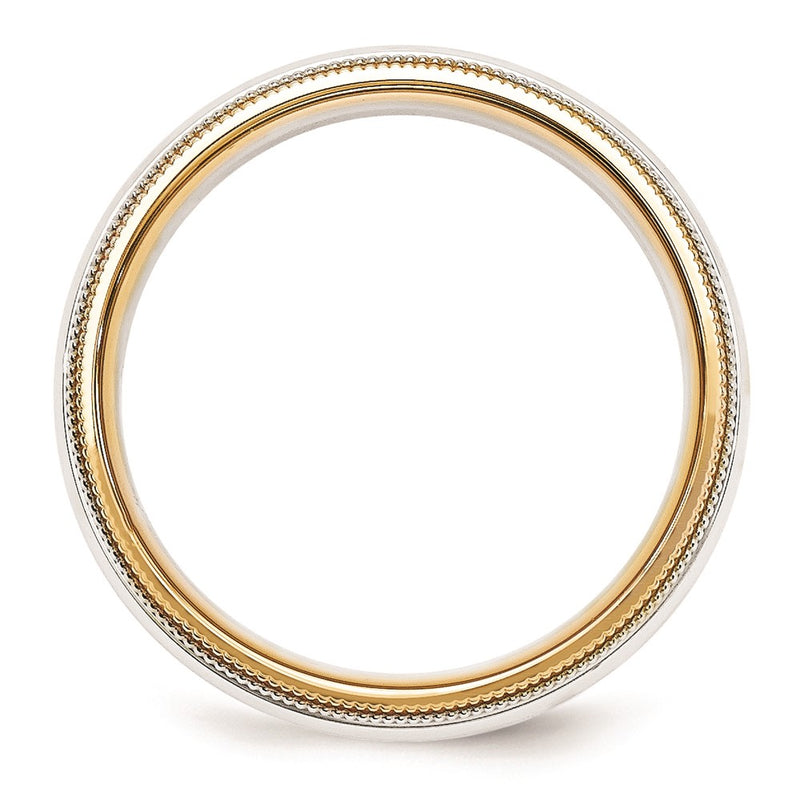
Milgrain is a decorative detail consisting of a row of tiny, uniform beaded edges applied along the border of a band. It gives the ring a subtle textured outline that reads as more ornate than a plain polished edge without being heavily decorative. On a two-tone band, milgrain can visually separate the contrasting metal zones and adds a slightly vintage-inspired character to an otherwise simple style.
In a shared prong setting, small prongs are positioned between adjacent stones and hold two diamonds at once, leaving more of each stone exposed for maximum light return. In a channel setting, the diamonds sit in a groove between two parallel walls of metal with no prongs between them, producing a sleeker, more protected profile. Shared prong bands tend to appear more brilliant; channel set bands have a cleaner, more architectural look and are less likely to catch on fabric.

Diamond engagement rings mark one of the most significant purchases most people...

Gold Charms & Charm Pendants | 10K & 14K Gold Jewelry Gold...

Fine jewelry gifts for him cover a wider range of styles and...

Mark this milestone achievement with jewelry that lasts a lifetime. Our graduation...

Let us help make your dream jewelry a reality! Use our easy three part Get-A-Quote form to begin the magic of creating your own,
custom designed jewelry. Fill in your Contact Information, Jewelry Information, Upload Images, and add any Notes - click Submit,
and one of our design team reps will be in touch within 12-24 hours.


